
Quick Summary
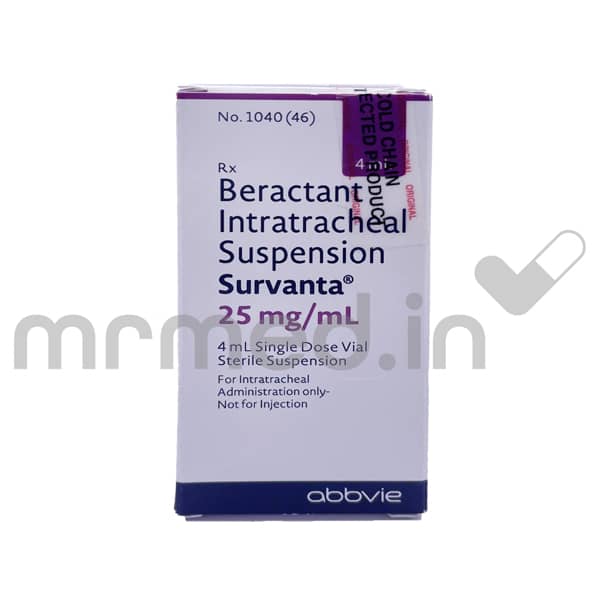
Survanta 200mg Injection


Last updated on 26 Sep 2026 | 08:44 AM (IST)
₹16772
MRP: ₹17479.47
(You Save ₹707.47)
1 VIAL(s) OF 8ML


Survanta 200mg Injection

Salt Composition
BERACTANTMarketer
ABBOTT
Prepaid Only. Non-Returnable.

4% OFF
₹16772
MRP: ₹17,479.47
Inclusive of all taxes
4% Off


Salt Composition
BERACTANTMarketer
ABBOTT
Prepaid Only. Non-Returnable.

Dispatch: Today
Care delivered without the wait. Your order is prioritized for rapid dispatch to ensure it reaches your doorstep on time.
Introduction
Survanta 200mg Injection contains beractant, a pulmonary surfactant derived from bovine lung tissue. It is supplied as an 8ml single-use vial containing 200mg of phospholipids, equivalent to 25mg/ml.
Survanta is used in premature newborns to replace deficient pulmonary surfactant and prevent or treat Respiratory Distress Syndrome (RDS), also known as hyaline membrane disease. It is administered directly into the airway through an endotracheal tube by healthcare professionals experienced in the care of premature infants.
Uses of Survanta 200mg Injection
Survanta 200mg Injection is used for:
Treatment of Respiratory Distress Syndrome in premature newborns with a birth weight of 700g or greater
Prevention of RDS in premature infants born before 32 weeks of gestation who are at risk of developing RDS and require intubation for stabilisation or have evidence of surfactant deficiency
Treatment is given in a highly monitored neonatal setting because the medicine can rapidly change lung compliance and oxygenation.
How Survanta 200mg Injection Works
Survanta replaces pulmonary surfactant that is deficient in the immature lungs of premature infants.
Pulmonary surfactant reduces surface tension inside the alveoli and helps keep the air sacs open during breathing. In premature infants with insufficient surfactant, the alveoli can collapse more easily, making breathing difficult and contributing to RDS.
After administration, beractant restores surface activity in the lungs, improves lung compliance and can improve oxygenation.
Interaction of Survanta 200mg Injection with other medicines
There are no known drug interactions with Survanta. However, the infant may be receiving other medicines and respiratory treatments as part of neonatal intensive care.
Tell the treating neonatal team about all medicines and treatments being given to the infant so that respiratory support and other aspects of care can be appropriately monitored.
Storage Conditions
Store Survanta at 2°C to 8°C.
Do not freeze.
Protect the vial from light and keep it in the original carton.
Before administration, the vial should be warmed to room temperature by standing for 20 minutes or by warming it in the hand for 8 minutes.
Do not use artificial warming methods.
Do not shake the vial. If settling occurs, gently swirl or invert it to redisperse the suspension.
A vial should not be returned to the refrigerator after warming.
Use the warmed vial within the period specified in the applicable product information.
Each vial is for single use only. Discard any unused medicine remaining after administration.
How to Use Survanta 200mg Injection
Survanta is administered intratracheally through an endotracheal tube. It must be given by or under the supervision of healthcare professionals experienced in neonatal intubation, ventilator management and the care of premature infants.
The recommended dose is 100mg of phospholipids per kg of birth weight, equivalent to 4ml/kg. Depending on the infant's clinical condition, up to four doses may be given during the first 48 hours of life, with doses administered no more frequently than every 6 hours.
For prevention, the first dose is given as soon as possible after birth, preferably within 15 minutes. For treatment of established RDS, the first dose should be given as soon as possible after RDS is confirmed, preferably by 8 hours of age.
The treating neonatal team will determine the dose and need for additional doses based on the infant's birth weight and respiratory condition.
Safety Advice
Pregnancy
Survanta is intended for administration to premature newborns and is not a medicine used to treat pregnant women. Pregnant women should not receive Survanta.
Breast Feeding
Survanta is intended for premature newborns and is not administered to breastfeeding women. Breastfeeding status does not affect the administration of this medicine to the newborn.
Lungs
Survanta is administered specifically to treat or prevent respiratory distress associated with pulmonary surfactant deficiency. It must be given in a setting where ventilation and respiratory monitoring are immediately available.
Liver
Survanta is administered directly into the lungs and is intended for premature newborns requiring specialised neonatal care. Tell the treating medical team about any known liver condition or other significant medical problem affecting the infant.
Alcohol
Survanta is administered to premature newborns under medical supervision. Alcohol consumption is not relevant to the intended use of this medicine.

Driving
Survanta is administered to premature newborns in a monitored neonatal care setting. Driving ability is not relevant to the infant receiving treatment.
Side Effects
Survanta can cause temporary reactions during or shortly after administration. These are generally associated with the dosing procedure and the rapid changes in lung function.
Common side effects
Slow heartbeat (bradycardia)
Decreased oxygen saturation
Reflux of Survanta into the endotracheal tube
Changes in blood pressure
Temporary breathing changes
Bradycardia and oxygen desaturation are among the more frequently reported reactions during the dosing procedure. If they occur, administration may be temporarily stopped until the infant is stabilised.
Serious side effects
The treating medical team will monitor for complications such as:
Significant airway obstruction
Apnoea
Severe oxygen desaturation
Respiratory deterioration
Pulmonary air leak
Pulmonary haemorrhage
Infection or sepsis
These complications can also occur in premature infants because of their underlying condition and cannot always be attributed directly to Survanta.
Expert Tips
Survanta should only be administered in a neonatal intensive care setting with appropriate respiratory support and monitoring.
The infant's oxygenation and ventilation should be monitored closely during and after administration.
Transient bradycardia or oxygen desaturation can occur during dosing. The healthcare team may pause administration and stabilise the infant before continuing.
Survanta can produce rapid improvements in oxygenation, so ventilator settings and oxygen requirements may need to be adjusted by the neonatal team.
Do not shake the vial. Gently swirl it if settling occurs.
The vial is intended for single use and any remaining medicine should be discarded.
Parents and caregivers should not attempt to administer Survanta themselves.
Follow-up respiratory care and monitoring remain essential even after surfactant treatment.
FAQs
Q1.
What is Survanta 200mg Injection?
Survanta 200mg Injection contains beractant, a bovine lung-derived pulmonary surfactant. It is used to prevent or treat Respiratory Distress Syndrome in premature newborns with surfactant deficiency.
Q2.
What is Survanta 200mg Injection used for?
Survanta is used to treat RDS in premature newborns with a birth weight of 700g or greater. It can also be used prophylactically in premature infants born before 32 weeks of gestation who are at risk of RDS and require intubation for stabilisation or have evidence of surfactant deficiency.
Q3.
How is Survanta 200mg Injection administered?
Survanta is administered directly into the airway through an endotracheal tube. It must be given by or under the supervision of healthcare professionals experienced in neonatal intubation and ventilator management.
Q4.
What is the usual dose of Survanta 200mg Injection?
The recommended dose is 100mg of phospholipids per kg of birth weight, equivalent to 4ml/kg. Additional doses may be given according to the infant's respiratory condition, up to a maximum of four doses during the first 48 hours, with at least 6 hours between doses.
Q5.
Can Survanta 200mg Injection be used in all premature babies?
No. The decision to use Survanta depends on the infant's gestational age, birth weight, evidence of surfactant deficiency, respiratory condition and need for respiratory support. The neonatal team determines whether treatment or prophylaxis is appropriate.
Q6.
Does Survanta 200mg Injection replace a ventilator?
No. Survanta replaces deficient pulmonary surfactant but does not replace respiratory support when ventilation is required. It is administered in a setting where appropriate ventilatory support is available.
Q7.
Can Survanta 200mg Injection cause breathing problems during administration?
Temporary changes in breathing, oxygen saturation or heart rate can occur during administration. The infant is continuously monitored, and dosing can be paused if significant bradycardia or oxygen desaturation occurs.
Fact Box
Molecule name | Beractant |
Therapeutic class | Pulmonary surfactant |
Pharmacological class | Exogenous pulmonary surfactant |
Indications | Prevention and treatment of Respiratory Distress Syndrome in premature newborns |
References
Disclaimer
MrMed’s primary intention is to ensure that its consumers get information that is reviewed by experts, accurate and trustworthy. The information and contents of this website are for informational purposes only. They are not intended to be a substitute for professional medical advice, diagnosis, or treatment. Please seek the advice of your doctor and discuss all your queries related to any disease or medicine. Do not disregard professional medical advice or delay in seeking it because of something you have read on MrMed. Our mission is to support, not replace, the doctor-patient relationship.
Did you find this information helpful?
Author Details

Written By
Naina Boruah
MSc Biomedical Science

Reviewed By
Dr. Tejashwin Adiga
MBBS
Last updated : 26 Sep 2026 | 08:44 AM (IST)

Want to know more?
Read Our Editorial Policy